


By Vibhuti Sharma
MUMBAI, Feb 17 (Reuters) - Global private equity investors like KKR and Blackstone have a new investment hotspot in India: cricket.
The Indian Premier League, the world's richest cricket league, counts Bollywood stars, Indian tycoons and spirits maker Diageo among its backers, but is now attracting major private equity firms with the prospect of rapidly rising revenue and profits and massive viewership globally.
The business value of the league, popularly called the IPL, surged to a record $18.5 billion last year, U.S.-based investment bank Houlihan Lokey says.
That's much smaller than America's National Football League (NFL) valued at $227 billion and the National Basketball Association (NBA) worth $165 billion, but on a per-match basis the IPL is now the world's second-most valuable sports league after the NFL.
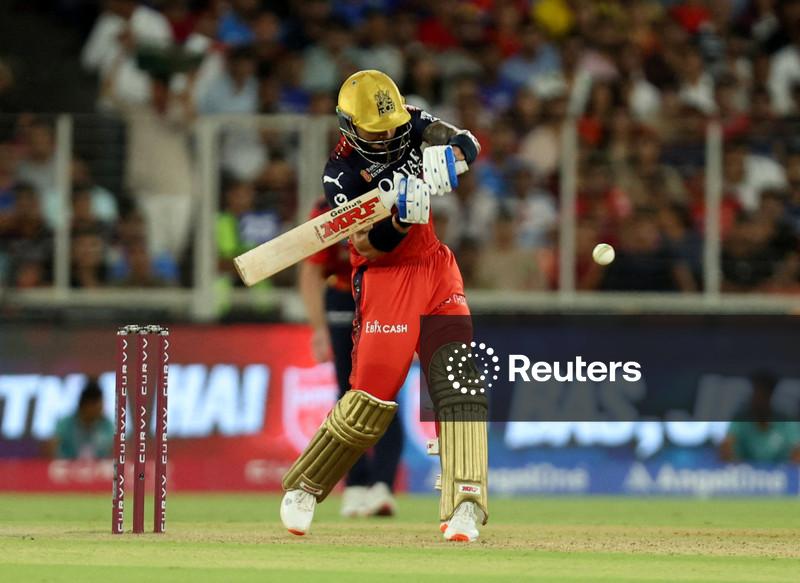
KKR and Blackstone are eyeing stakes in the winner of last season, Royal Challengers Bengaluru (RCB), two banking sources said. KKR is also reviewing a possible stake in the Rajasthan Royals team, while Swiss-based PE firm Partners Group is considering at least one team for investment, sources said.
It was a blockbuster IPL deal by European private equity firm CVC Capital that triggered the new wave of interest among investors, bankers say. CVC sold a majority stake in the Gujarat Titans, netting a return of more than 350% in dollar terms just four years after acquiring it. The deal valued the team at $900 million.
"India's structural economic growth should continue to support long-term value creation," said Siddharth Patel, a managing partner at CVC Capital.
"Combined with the scarcity of IPL franchises, it is clear why there is such intense investment interest from both industrial groups, family offices and private equity investors.”
Since the CVC deal, several enquiries have come in from private equity clients in the U.S. and Europe for IPL stakes, said Harsh Talikoti, a sports deals specialist at Houlihan Lokey in Mumbai.
"The IPL model proved you can generate serious profit," he said.
Blackstone, KKR, Partners Group and Royal Challengers Bengaluru declined to comment, while Rajasthan Royals did not respond to Reuters' requests for comment. The sources declined to be named as the talks are private.
CENTRALISED POOL AND BROADCAST RIGHTS BOUNTY
The IPL has reshaped the game in a country where the top cricketers are often worshipped. Last year, IPL had a record 1.19 billion viewers across digital and TV, far larger than the NFL.
Each year after an auction for global players, IPL teams compete in matches in the 20-over format of the game. The next season starts March 26.
Key factors driving investor interest in the league are a doubling in the value of broadcast rights to more than $6 billion in the most recent auction in 2022, rising franchise revenues and the Indian cricket board BCCI's pooled revenue-sharing model that bolsters team revenues.
The board pools media rights and league sponsorship funds, keeps half, and distributes the rest equally among the teams - a structure far more centralised and evenly shared than, say, in the NBA.
The model ensures each team is well-funded to acquire players, and with regular player auctions, any team can contend for the title in a season, CVC's Patel said. That helps "maintain strong audience engagement and provides franchises with predictable economics through the media rights cycle."
Mohit Burman, an Indian businessman who co-owns the Punjab Kings team with Bollywood star Preity Zinta, said his sponsorship revenue grew 30% a year, but the key lure for private equity firms was the revenue-sharing model.
"The IPL can certainly rival - and in some cases outperform - U.S. leagues on investor returns, even if the absolute scale differs," Burman told Reuters.
Every IPL franchise earns around $55 million alone from the board's pool annually, he said. Ticket sales and other sponsorship earnings are on top of this.
"The asset class has clearly come of age," Burman said.
The BCCI and other IPL teams did not respond to Reuters' queries.
THE INVESTMENT RISKS
Reliance and Disney merged their India businesses in 2024, and now together own the streaming and TV broadcast rights for IPL until 2027 which cost $6.2 billion. Jefferies analysts say the per-match value just on those rights makes IPL the second-highest valued globally after the NFL.
But there are risks for investors, too.
With similar leagues finding traction in South Africa, UAE and Australia, cricketers must navigate an increasingly crowded franchise calendar alongside their international commitments.
The biggest overhang is the worry that the Disney-Reliance merger will mean less competition and could result in fewer dollars for teams in the 2027 broadcast auction.
Indian billionaire Sanjiv Goenka doesn't agree. He said in an interview last year that his 2021 acquisition of an IPL team for $781 million is a "trophy business" and broadcast rights will only get pricier.
Many investors, including Goenka's Group and Mukesh Ambani's Reliance, bet a total of 500 million pounds last year in the England and Wales Cricket Board's hundred-ball league.
RISING TEAM REVENUES
The NFL opened its teams for private equity investors in 2024, and the NBA allows such investments but with strict ownership caps. IPL has no such limits, permitting greater private capital play.
Team revenue, earnings growth and the limited number of teams are big allures. There are 10 teams in the IPL, compared to 32 in the NFL.
A Reuters analysis of regulatory disclosures showed at least five IPL teams more than doubled their revenue, on an absolute basis, since 2022, with two of them even doubling their profits. Three other franchises also recorded a doubling of profits - but not revenue - in the period.
Kolkata Knight Riders, part-owned by Bollywood star Shah Rukh Khan, reported revenue of $76.8 million for 2023-24, up 119% from the previous year. Net profit rose six times to $19.4 million.
Sumat Chopra, private equity head at consultancy Kearney which has advised clients on the IPL, said there's more upside as marquee players bolster team revenues. Top players like India's Virat Kohli and Australia's Pat Cummins play the IPL.
"IPL franchise valuations are likely to compound steadily over time, supported by rising media economics."
($1 = 90.7500 Indian rupees)
(Reporting by Vibhuti Sharma in Mumbai; Additional reporting by Amlan Chakraborty; Editing by Aditya Kalra and Sonali Paul)
Did you find this insightful?
Bad
Just Okay
Amazing