Dollar Logs Worst Year Since 2017 as Rate Cuts Open the Global Trust Trapdoor… Bitcoiners Vindicated
Listen, I’m not saying the U.S. dollar is washed. And I’m definitely not saying we should start engraving “In Jerome We Trust” on Monopoly money just yet.
But what I am saying is that if the dollar were a once-dominant athlete, this is the part of the documentary where the narrator lowers his voice and says, “Then… the decline began.”

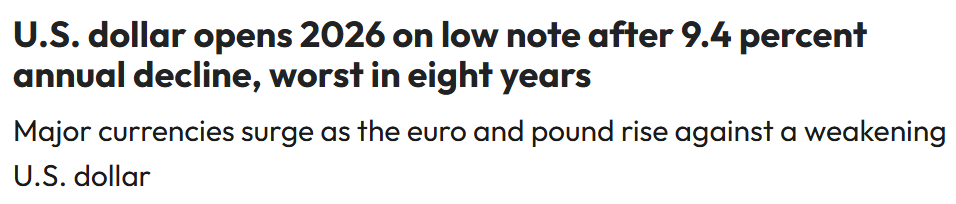
Because the greenback just had its worst year since 2017, down 9.5% against a basket of major currencies. That’s not a pullback. That’s a “did we leave the stove on?” moment. To put it in teenage lingo: the dollar is getting cooked… slowly… by its own central bank.
The main culprit is gonna shock you… it’s the Federal Reserve. After spending years white-knuckling high rates like a dad refusing to admit he missed the exit, the Fed finally blinked in September and started cutting. And Wall Street thinks that was just the opening act. Traders are pricing in two to three more quarter-point cuts by the end of 2026.
(Source: Economy Middle East)
Meanwhile, other central banks are doing the exact opposite. The European Central Bank is essentially saying, “Rates? Yeah… we might keep those tight.” President Christine Lagarde even hinted that all options are on the table… which is central banker for don’t get comfy.
Translation? Capital flows where it’s treated best. And right now, the U.S. is offering lower yields with a side of political chaos.
Meanwhile, the euro gained nearly 14% higher last year, pushing past $1.17, a level not seen since 2021. Wall Street banks think $1.20 is on deck by the end of next year. The pound wasn’t far behind, finishing the year at $1.36.
As Deutsche Bank’s FX chief George Saravelos put it, this has been one of the worst years for dollar performance in the history of free-floating exchange rates. That’s a long way of saying: this isn’t normal.

Sure, the initial downfall came after Donald Trump kicked off tariff wars that rattled global confidence. At one point, the dollar was down 15% before clawing some of it back. But the pressure never really left. Rate cuts just kept the wound open.
And the future isn’t exactly calming nerves. Investors are already pre-stressing over Trump’s eventual replacement for Jay Powell. If the next Fed chair looks like someone who takes rate-cut suggestions directly from the Oval Office (and they absolutely will), expect another wave of dollar skepticism. Bond investors are already whispering about a more “interventionist” Fed.
That’s not to say U.S. stocks won’t keep ripping. As crazy as it may seem, AI spending is real. Tech growth on the West Coast is still leaving Europe in the dust. And everyone knows that no matter what tariffs Trump decides to cook up this year, it won’t derail that machine.

Of course, that presents another problem. You see, stocks going up doesn’t automatically mean the dollar goes up anymore. What do I mean by that? Well, foreign investors are now hedging their dollar exposure when buying U.S. equities. That means derivatives. That means pressure. That means fewer raw dollar inflows propping up the currency.
So yes, the dollar has bounced +2.5% off its September lows. And no, it’s not losing reserve-currency status tomorrow morning. But I think it’s starting to get pretty obvious this isn’t a temporary slump… more like a slow, structural reassessment.

Not necessarily a collapse… or even a crisis. Just the realization that the dollar isn’t the undisputed main character it used to be… and the rest of the world is starting to price that in. Which, conveniently, is the entire Bitcoin pitch. And when the data keeps showing up like this, it gets harder to pretend the internet weirdos are completely wrong.
At the time of publishing this article, Stocks.News holds positions in Bitcoin as mentioned in the article.