Amazon Just Jumped Into the Quantum Wars… But Analysts See One Huge Red Flag
In case you missed it (because, you know, you were busy doing literally anything else last week) Microsoft pulled back the curtain on its quantum computing chip that, according to them, has been in the works for 20 years. That’s two decades of nerds in lab coats squinting at electrons, all so they could finally announce their fancy new “Majorana 1” processor.
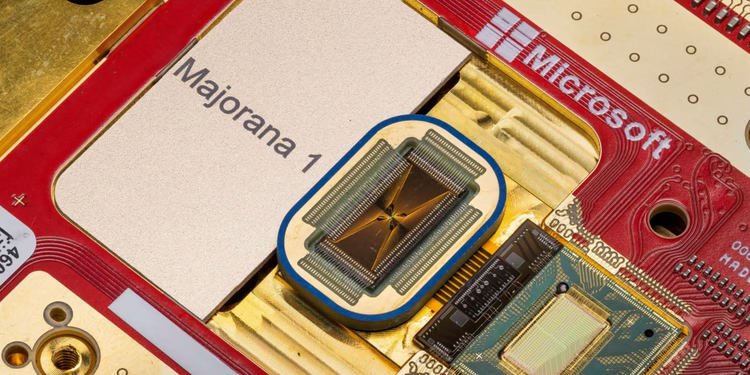
(Source: Microsoft)
Well, it seems Amazon’s execs saw that news, chugged a Red Bull, and immediately fired off a Slack message to their top devs that read: “Spin up a quantum chip. ASAP.” And just like that, Ocelot was born.
Yes, this morning Amazon debuted its first-ever quantum computing chip, officially throwing its hat into the quantum race alongside Microsoft and Google. If it feels a little sudden, that’s because it is. One week after Microsoft unveiled its quantum breakthrough, Amazon conveniently announced that it, too, had been working on a chip that will revolutionize computing as we know it (whatever you say, Jeff).

So what exactly does Ocelot do? Well, for those who didn’t take Quantum Physics as an elective, here’s the short version. Regular computers run on bits, which are basically tiny switches that flip between 1s and 0s. Quantum computers, on the other hand, use qubits, which can be both 1 and 0 at the same time. If that sounds like witchcraft, it kind of is. But the end result is that quantum computers can process calculations at speeds that make today’s fastest supercomputers look like an old-school calculator. (Yes, the one you used to play Snake on in high school.)
The problem is that qubits are notoriously finicky. Even the slightest environmental disturbance (heat, radiation, or a software engineer sneezing near the server) can introduce errors, which makes them unreliable. Amazon says Ocelot solves one of the biggest problems in the quantum world: error correction. The idea is that Ocelot’s architecture will help reduce the chaos and bring us one step closer to a practical, real-world quantum computer. In theory, this means quantum systems could eventually solve problems that would take today’s best computers thousands of years to figure out.

This is a little different from when Microsoft made headlines last week with its Majorana 1 chip, which supposedly uses some mysterious new material called a topoconductor. According to Microsoft, this material enables a new state of matter that isn't solid, liquid, or gas but something called a topological state. The company claims this will allow for more stable qubits, which would be huge because quantum computing’s biggest hurdle right now is keeping qubits from erroring out every five seconds.
But there’s a catch… many experts are skeptical that Microsoft’s breakthrough is even real. Microsoft has been burned before for making quantum computing claims that didn’t hold up under scrutiny, so while Majorana 1 is ambitious, it’s also untested and still theoretical.

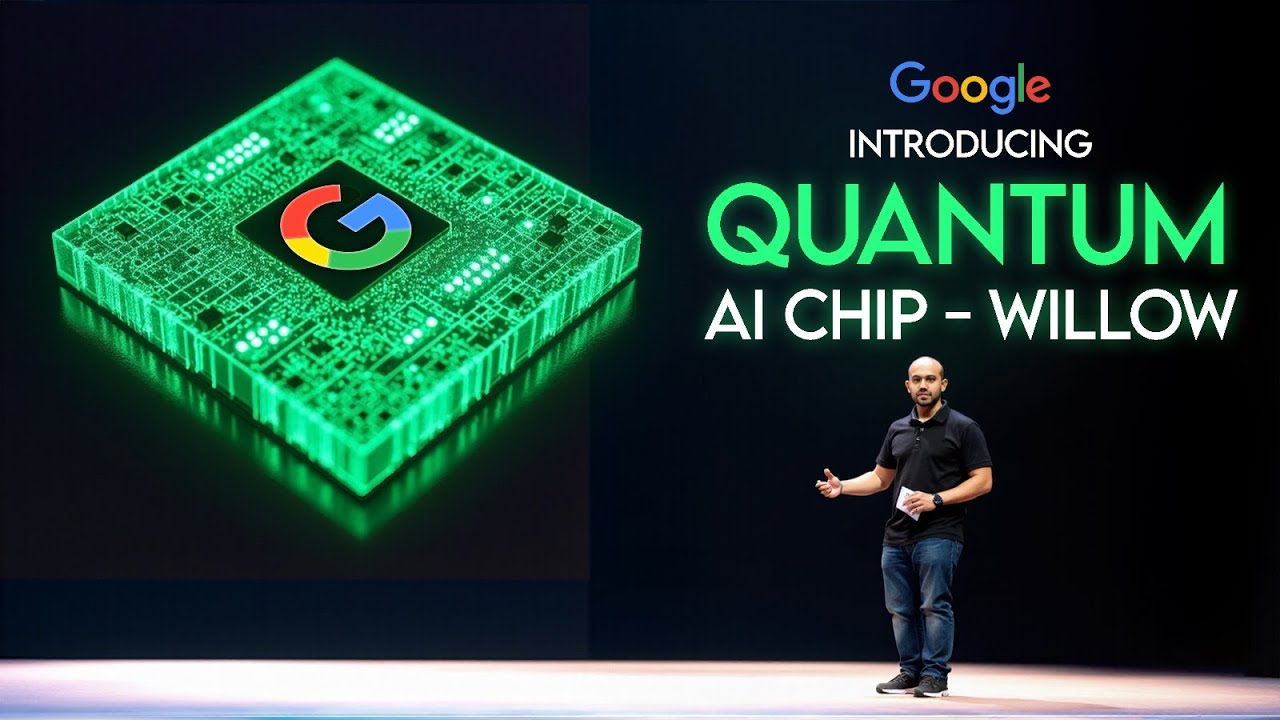
Google’s Willow chip, launched in December, takes a different approach. Instead of relying on a new material like Microsoft, Willow builds on Google’s existing quantum tech by focusing on superconducting qubits, the most widely used and understood qubit design today. What makes Willow stand out is that it’s designed with 105 qubits, a huge leap from Amazon’s Ocelot chip, which has just nine qubits.
Google’s goal with Willow is better error correction (something Amazon is also working on with Ocelot) but with a lot more horsepower. Willow’s higher qubit count means it has a better shot at handling real-world computations, while Amazon’s Ocelot is still in the early experimental phase.
All this to say, the Big Tech battle for quantum supremacy is officially on, and the winner will do far more than increase their cloud subscription sales (although that’s a huge plus)… it will shape the future of computing itself.
So when will we actually see quantum computers become useful? Depends on who you ask. Amazon’s top quantum execs say it’ll take at least a decade before commercial workloads can realistically run on these systems. Nvidia CEO Jensen Huang is even less hopeful, putting the timeline at closer to 20 years. Intel’s former CEO Pat Gelsinger seems to think we could see useful quantum computing by 2030. The predictions vary, but one thing is certain: whoever gets quantum computing right first is going to have the rest of the industry kissing the ring.
PS: If you want stock picks and trade ideas every single day (in addition to breaking news)… you should definitely check out our premium membership. Our team of real investors digs through SEC filings and insider trades daily, flagging opportunities that stand out. When we spot a can’t-miss trade, we break it down in a full write-up… on top of all the other perks you get as a premium member. Check it out here.
Stock.News has positions in Microsoft, Amazon, and Google.